
The Hidden Costs of Frameless Motor Integration: A TCO Model for Procurement
Use this frameless motor TCO model to compare kit price, housing, thermal design, QA, and lifecycle risk before issuing a robotics or OEM RFQ.
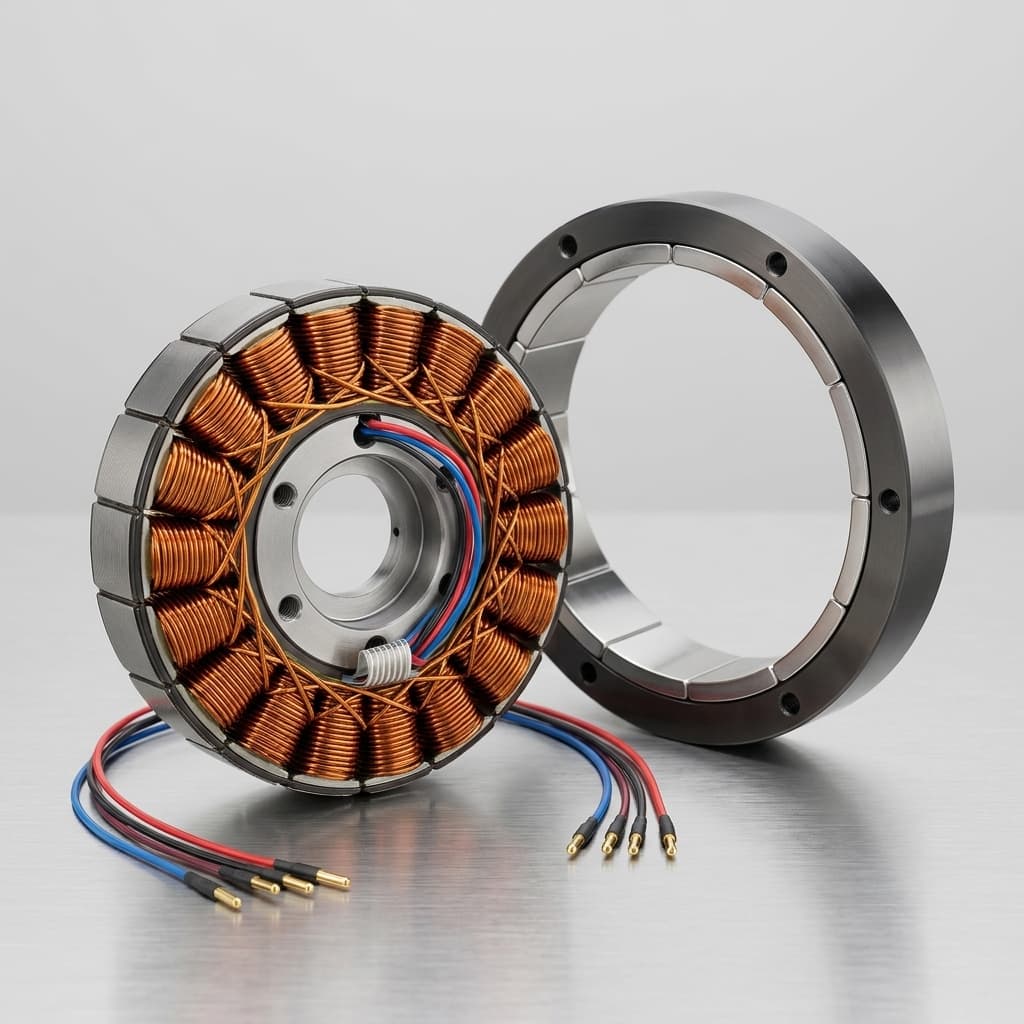
The transition toward highly integrated, lightweight robotics and automation systems has driven a massive surge in the adoption of frameless brushless DC (BLDC) motors. By eliminating the traditional motor housing, bearings, and shaft, frameless motors allow engineers to integrate the rotor and stator directly into the host machine’s structure. This results in superior torque density, extreme compactness, and the elimination of mechanical backlash.
However, this architectural shift introduces a significant blind spot for procurement teams. When evaluating frameless motors, buyers often look at the raw Bill of Materials (BOM) cost of the motor kit—which appears deceptively low. What is frequently omitted from the initial financial models is the massive burden of thermal management, precision machining, and custom engineering that shifts from the motor manufacturer to the system integrator.
This technical guide dissects the physics of frameless motor integration, outlines a realistic Total Cost of Ownership (TCO) model, and provides a framework for procurement and engineering teams to align on supplier selection. We will cover the applicability boundaries, specification dimensions, failure risks, and crucial buyer decision points to help you make an informed sourcing choice.
Scope note (updated July 18, 2026): This model is for global OEM procurement and engineering teams evaluating frameless BLDC or torque motor kits for robotics, AGV/AMR, exoskeleton, and compact automation programs. It is not a substitute for supplier torque-speed curves, thermal FEA, safety certification review, or prototype dynamometer testing.
If you already have a duty cycle and housing envelope, use this article as an RFQ worksheet; QDD Motors can review the thermal path, winding voltage target, encoder assumptions, and volume forecast before quotation through Contact Engineering.
The Physics of Frameless Motor Thermal Derating
To understand the hidden costs of frameless motors, one must first understand how they manage heat. In a traditional housed motor, the manufacturer designs the casing, the cooling fins, and sometimes an internal fan. When that manufacturer specifies a "continuous torque" rating on the nameplate, it is based on the known thermal dissipation capabilities of that specific housing.
With a frameless motor, there is no housing. The motor consists only of a bare stator (which generates the heat) and a rotor (which contains the magnets). The continuous torque rating provided by the supplier is purely theoretical—it assumes the motor is mounted to an "infinite heatsink" (typically a massive aluminum plate used in their testing laboratory).
Copper Losses and Core Losses
When a motor operates, it generates heat primarily through two mechanisms:
- Copper Losses (I2R): The resistance of the copper windings generates heat proportional to the square of the current drawn. During high-torque maneuvers, this heat spikes rapidly.
- Core Losses: Alternating magnetic fields cause hysteresis and eddy currents in the steel laminations of the stator, generating additional heat that scales with motor speed.
If this heat is not aggressively wicked away from the stator, the internal temperature will rise until the winding insulation degrades or, catastrophically, the permanent magnets on the rotor exceed their Curie temperature and permanently demagnetize.
Applicability Boundaries and Failure Risks
Understanding where frameless motors excel and where they fail is critical.
- Applicability Boundaries: Frameless motors are ideal for low-speed, high-torque applications (like robotic joints, exoskeleton hinges, and AGV wheels) where space is constrained and the host housing can act as a heatsink. They are poorly suited for standalone applications without a robust thermal path or environments requiring rapid, drop-in replacements.
- Failure Risks: The primary failure mode is thermal breakdown of the winding insulation due to inadequate heat sinking. Another severe risk is mechanical interference; if the integrator's housing distorts under thermal load or mechanical stress, the incredibly tight air gap between the stator and rotor may close, causing them to grind against each other and destroy the motor instantly.
The Integrator's Burden: Thermal Resistance (Rth)
Because the frameless motor relies entirely on the host equipment for heat dissipation, the true continuous torque of the actuator is dictated by the thermal resistance (Rth) of the buyer's mechanical design. If the robot joint or AMR chassis acts as a thermal insulator rather than a heatsink, a motor rated for 50 Nm of peak torque might only safely deliver 10 Nm of continuous torque.
This leads to a common, costly procurement trap: buying a larger, more expensive motor to meet torque requirements, when the cheaper engineering solution would have been to optimize the thermal path of a smaller motor.
Breaking Down the Total Cost of Ownership (TCO)
When building a TCO model for frameless motors, procurement teams must look across a 5-to-10-year lifecycle, accounting for upfront R&D, unit production costs, and long-term maintenance. Furthermore, evaluating the specification dimensions properly ensures that no hidden costs surprise the organization late in the development cycle.
For procurement scoring, normalize quotations with:
5-year TCO = NRE + V x (motor kit + housing machining + TIM + assembly labor + inspection + scrap reserve) + field service reserve
Where V is planned production volume over the sourcing window. This model is most useful before prototype freeze, when engineering can still trade motor frame size, winding choice, housing material, bearing stack, and assembly method. For integrated joint programs, compare the result against your QDD actuator envelope and interface requirements before locking the RFQ.
1. Direct Component Costs (The "Kit")
This is the invoice price from the motor supplier. It includes the copper windings, the laminated steel stator, the permanent magnet rotor, and typically a basic Hall effect sensor or encoder ring. While this cost is lower than a fully housed motor, it represents only the tip of the TCO iceberg.
2. Materials and Machining Costs (The "Housing")
Because the motor must be integrated into the robot, the host structure must be precision-machined. The air gap between the rotor and stator in a frameless motor is incredibly small (often less than 0.5mm). If the integrator's housing has poor concentricity or lacks stiffness, the rotor will strike the stator, destroying the motor.
- Cost Driver: High-precision CNC machining for bearing journals and stator mounting surfaces.
- Cost Driver: Thermal Interface Materials (TIMs), structural epoxies, or potting compounds required to secure the stator and transfer heat.
3. Engineering and R&D Costs
The most significant hidden cost is upfront engineering time. Developing a successful frameless actuator requires:
- FEA Thermal Modeling: Simulating how heat flows from the stator through the TIM and into the host aluminum structure.
- Tolerance Stack-Up Analysis: Ensuring that bearing play, thermal expansion, and machining tolerances do not close the critical air gap.
- Prototyping: Multiple iterations are often required to validate thermal derating curves in real-world conditions.
4. Operational & Maintenance Costs
This is where frameless motors heavily subsidize their high upfront costs. Because frameless integration often eliminates flexible couplings, bulky external housings, and complex gear trains, the resulting actuator has fewer moving parts. Over a 10-year lifecycle, the reduction in preventative maintenance, lubrication replacements, and mechanical failures often results in a significantly lower TCO compared to traditional bolted-on motor setups.
TCO Comparison: Housed vs. Frameless Motors
The table below outlines the shift in cost burdens between a traditional housed servomotor and a frameless motor kit, acting as a crucial buyer decision point matrix.
| Cost Dimension | Traditional Housed Motor | Frameless BLDC Motor Kit | TCO Impact Driver for Frameless |
|---|---|---|---|
| Initial Purchase Price | High (Includes housing, bearings, shaft) | Low to Moderate (Bare rotor/stator only) | Appears cheaper on initial BOM, masking downstream costs. |
| Thermal Management | Handled by supplier; specs are guaranteed | Handled by OEM; specs are highly dependent on design | High risk of thermal derating if OEM integration is suboptimal. |
| Mechanical Engineering | Low (Simple bolt-on mounting) | Extremely High (Precision concentricity required) | Requires advanced DFM, FEA analysis, and precision CNC capabilities. |
| Assembly Complexity | Low (Plug and play) | High (Requires specialized tooling, epoxies, alignment) | Increases factory floor assembly time and requires stricter QA processes. |
| System Weight & Size | Heavy and bulky | Extremely lightweight and compact | Massive indirect cost savings in mobile robotics (longer battery life, higher payloads). |
| Long-Term Maintenance | Moderate (Bearings, couplings wear out) | Very Low (Fewer failure points, direct drive) | Drastically reduces 10-year lifecycle maintenance costs. |
| Overall TCO (High Volume) | High (Paying supplier margins on housings) | Low (Amortized engineering costs lead to cheap units) | At high volumes, frameless TCO is unbeatable. |
Specification Dimensions & Buyer Decision Points
When transitioning to a frameless motor platform, procurement must work closely with engineering to establish clear specification dimensions and buyer decision points. A generic RFQ will not suffice. You need to define the exact parameters of the motor and how it interacts with the system.
Buyer Decision Points:
- Standard vs. Custom Winding: Do you buy an off-the-shelf winding that closely matches your requirements, or pay NRE for a custom winding that perfectly matches your voltage and RPM needs to minimize heat? Custom windings often yield better TCO at scale.
- Encapsulation (Potting): Do you want the supplier to pot the stator in a thermally conductive epoxy before shipping? This increases piece price but drastically reduces your assembly complexity and improves reliability.
- Magnet Grade Identification: What is the maximum ambient temperature the motor will see? This determines the required magnet grade (e.g., N42SH vs N42UH). Upgrading the magnet grade increases cost but mitigates the risk of catastrophic demagnetization.
Sourcing Strategy: Bridging Procurement and Engineering
To successfully source frameless motors without suffering from cost overruns, procurement teams must evolve their supplier evaluation criteria. You cannot buy a frameless motor like a commodity component; you are entering into an engineering partnership.
1. Evaluate Supplier DFM Support
Does the motor manufacturer simply ship you a box of stators and rotors, or do they provide Design for Manufacturing (DFM) support? Elite suppliers provide comprehensive integration guides, thermal resistance data, and 3D CAD models that include recommended interference fits and tolerancing.
2. Supplier Communication Fields
Clear communication channels must be established. The RFQ should explicitly request:
- Rth (Thermal Resistance) data from the stator winding to the outer lamination diameter.
- Recommended clearance and interference fits for different host materials (e.g., Aluminum vs. Steel).
- Material safety data and compatibility matrices for recommended thermal epoxies.
- Stator outer diameter (OD) and rotor inner diameter (ID) tolerances.
3. Ask for Custom Winding, Not Just Custom Sizes
Instead of paying massive NRE (Non-Recurring Engineering) fees for a custom motor diameter, work with suppliers who offer custom stator windings on standard frame sizes. By tweaking the wire gauge and turn count, a supplier can perfectly match the motor's Kv (RPM/Volt) to your system voltage, maximizing efficiency and minimizing heat generation without altering the mechanical footprint.
The Frameless Motor Integration Checklist
Before finalizing a purchase order for frameless motors, ensure your cross-functional teams have addressed the following procurement, acceptance, spec confirmation, and inquiry fields:
- Thermal Path Validated: Has engineering performed FEA analysis to prove the host structure can dissipate the required watts of heat to maintain continuous torque?
- Interference Fits Calculated: Have the interference fits for pressing the stator into the housing been calculated across the entire operating temperature range to account for different coefficients of thermal expansion (CTE)?
- Air Gap Protection: Is the bearing architecture stiff enough to prevent deflection under maximum radial and axial loads?
- Assembly Tooling Designed: Has manufacturing engineering designed the necessary fixtures to safely insert the highly magnetic rotor into the stator without injury or damage?
- Sensor Alignment: If using a frameless encoder or Hall sensors, is there a rigid, precise mounting location built into the housing design?
- Supplier Data Verified: Has the supplier provided the thermal resistance (Rth) from the winding to the stator outer diameter?
- Procurement & Specs Confirmation: Are lead times for custom windings established, and are the acceptable variance limits for stator OD and rotor ID explicitly defined in the PO?
- Acceptance Testing: Do you have a dynamometer setup ready to verify the motor's Kv, Kt, and continuous torque upon initial batch receipt?
- Inquiry Fields Prepared: Does your RFQ include specific questions about the supplier's potting compound options, thermal resistance data, and long-term magnet degradation curves?
Engineering & Buyer FAQ
Q: Why does the motor data sheet show a continuous torque of 20 Nm, but our prototype overheats at 8 Nm?
A: Motor data sheets state continuous torque based on a specific, massive aluminum heatsink used in their lab (often 10x10x1 inches). If your robot's joint is thin-walled aluminum or composite, it cannot pull heat away fast enough. You are experiencing thermal derating.
Q: What is the best way to secure the stator into the host housing?
A: The most robust methods are thermal interference fitting (heating the housing, dropping the stator in, and letting it cool to shrink-fit) or using high-performance structural thermal epoxies. Set screws should be aggressively avoided as they deform the stator laminations and degrade magnetic performance.
Q: Can we use frameless motors in environments with dust or liquid?
A: Yes, but because the motor lacks a sealed housing, your overall machine design must provide the IP67/IP68 sealing. Pre-potted stators can protect the windings, but the air gap must remain free of ferromagnetic debris.
Q: How do we compare the TCO of a frameless motor kit to a fully housed motor if the kit requires internal R&D? A: Procurement should demand an itemized engineering budget from the internal R&D team for housing design, CNC machining, and thermal FEA. Add this NRE (Non-Recurring Engineering) cost to the projected volume of frameless kits over 3-5 years. Typically, the breakeven point occurs at moderate-to-high volumes where the savings on the BOM outweigh the initial R&D.
Q: Are there hidden supply chain risks with frameless motors? A: Yes. A frameless motor relies heavily on rare-earth magnets (usually Neodymium). If your supplier does not have a robust, transparent magnet sourcing strategy, you may be exposed to severe price volatility and geopolitical supply chain shocks. Always ask for their magnet supply chain provenance during the initial RFQ stage.
Optimize Your TCO with QDD Motors
Mastering frameless motor integration requires a deep understanding of electromagnetics, thermodynamics, and precision manufacturing. If your engineering team is spending too much time designing motor housings instead of advancing your robot's core capabilities, it's time to collaborate with experts.
QDD Motors provides not just high-performance frameless kits, but the deep DFM support, custom winding, and pre-potted thermal solutions required to guarantee your continuous torque specs and minimize your Total Cost of Ownership.
Contact our engineering team to discuss your frameless integration challenges and request detailed thermal models for your next generation of actuators.
Sources & References
- Alva Industries. "An Engineer's Guide to Frameless Motors." Available at: https://www.alvaindustries.com/post/an-engineers-guide-to-frameless-motors
- Lin Engineering. "Frameless Motors." Available at: https://www.linengineering.com/products/frameless-motors
- Kollmorgen Design Resources. "Frameless Motors: What Are They, How Do They Work, and When Should You Use Them?" Available at: https://www.kollmorgen.com/en-us/developer-network/frameless-motors-what-are-they-how-do-they-work-and-when-use-them
Author

Categories
More Posts
48V vs. 96V QDD Motors for Humanoid Robots: A System-Level Procurement Guide
Compare 48V vs 96V QDD Motors for humanoid robots with thermal, cable, safety, supply-chain, and RFQ checks for global OEM teams.
Selecting Frameless Torque Motors for Surgical Robotics: A Procurement and Engineering Guide
Specify frameless torque motors for surgical robotics with procurement checks for cogging torque, thermal limits, hollow bores, and QDD Motors support.
IP67 QDD Motors for Outdoor Humanoids: Thermal Constraints & Procurement Guide
A comprehensive engineering and procurement guide for sourcing IP67 waterproof Quasi-Direct Drive (QDD) actuators for outdoor humanoids and quadruped robots.