
Frameless Torque Motors: The Ultimate Guide for CNC and Automation Integration
Learn how frameless torque motors (stator and rotor sets) are integrated into high-precision CNC machines, robotic joints, and custom automation equipment.
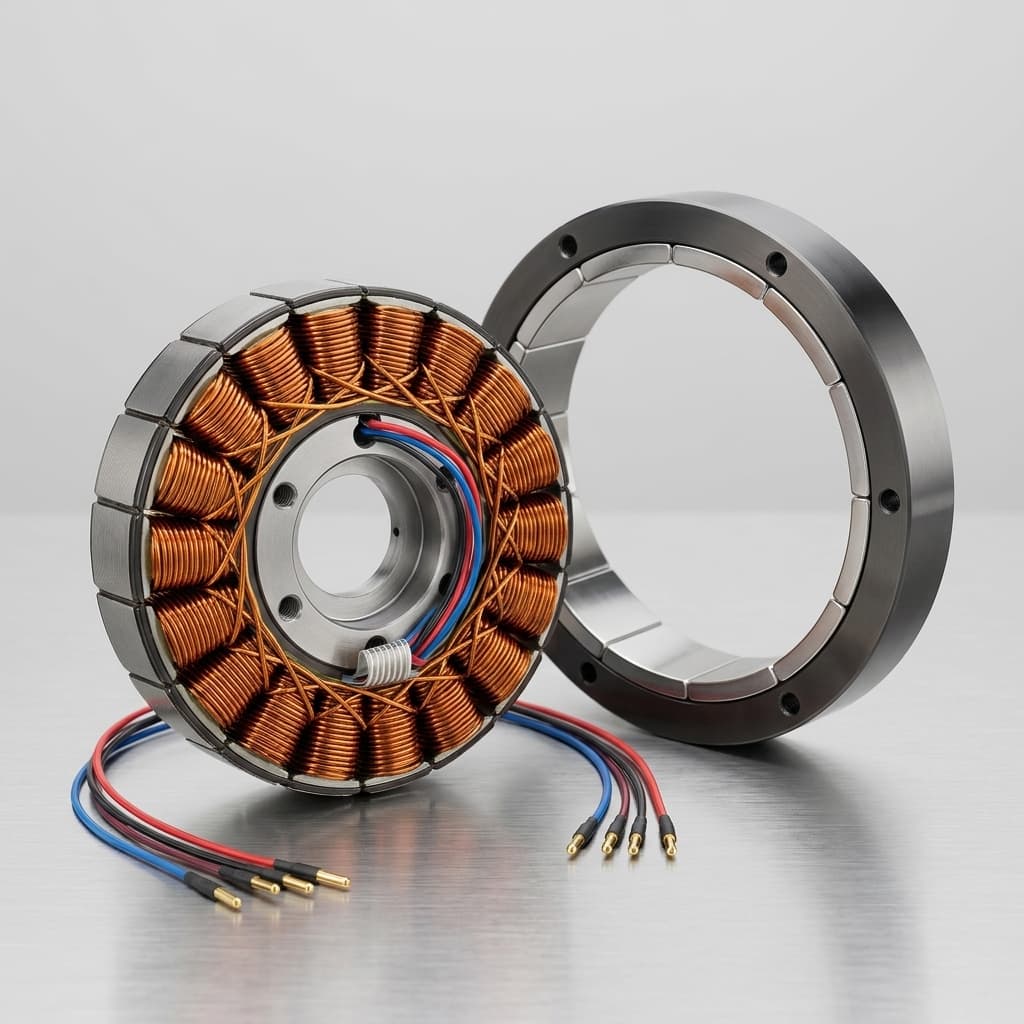
Standard housed motors often fail to meet the strict volume and weight constraints of custom automation. Frameless torque motors—consisting solely of an active electromagnetic stator and a permanent magnet rotor—provide the necessary mechanical integration.
This article outlines the mechanical integration considerations for frameless torque motors in high-precision CNC and automation systems.
What is a Frameless Torque Motor?
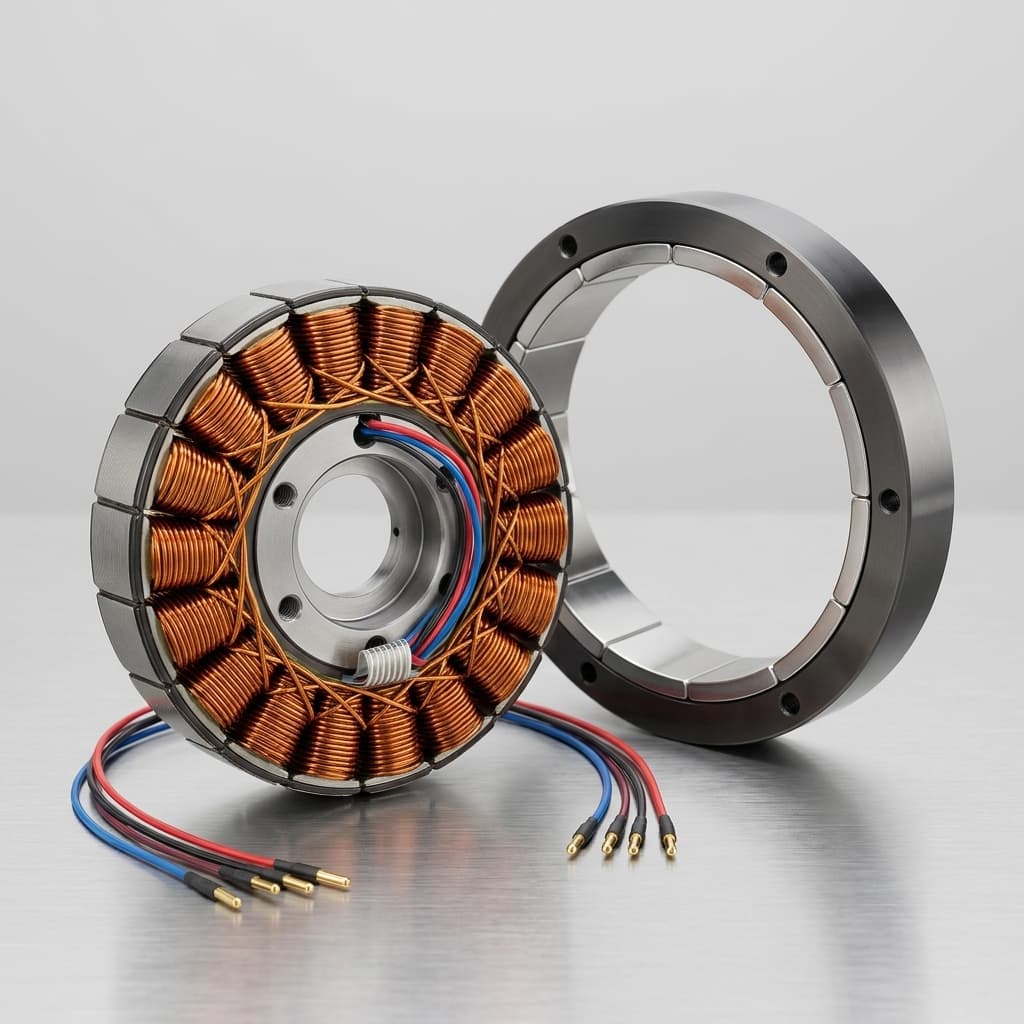
A frameless motor is a brushless permanent magnet motor supplied without a shaft, bearings, or outer housing. The customer receives a stator (the stationary part with copper windings) and a rotor (the rotating part with permanent magnets).
The machine builder must design the mechanical housing, select the bearings, and handle the shaft integration themselves. While this requires more engineering effort upfront, the performance payoffs are massive.
The Advantages of Direct Mechanical Integration
1. Zero Backlash and High Stiffness
Because the rotor is bonded or shrink-fitted directly onto the driven shaft of the machine (such as a CNC rotary table), there are no couplings, belts, or gearboxes required to transmit power. This direct-drive approach eliminates mechanical backlash entirely, resulting in incredibly stiff systems with infinite resolution.
2. Maximum Power Density
By eliminating the redundant motor housing and bearings, frameless motors save significant weight and volume. The motor becomes an integral structural part of the machine itself, leading to highly compact machine designs.
3. The Power of High Pole-Counts
Frameless torque motors are usually designed as high-pole-count synchronous motors. By increasing the number of magnetic poles (e.g., 24 or 36 poles instead of the typical 8 poles found in high-speed spindles), the motor generates significantly more torque at lower speeds. This electromagnetic gearing effect is what allows direct-drive rotary tables to produce massive holding torque without relying on a mechanical gear reducer.
4. Large Hollow Bores
Frameless torque motors are naturally designed with large inner diameters. This generous hollow shaft allows engineers to route lasers, fiber optics, electrical cables, or cooling fluids directly through the center of the rotational axis, which is essential in applications like gimbal systems and robotic wrists.
Common Applications
Frameless motors are the backbone of modern high-performance motion control:
- CNC Rotary Tables and Mill-Turn Centers: Providing the massive torque and zero-backlash precision needed for 5-axis machining.
- Collaborative Robot (Cobot) Joints: Housed directly inside the robot arm alongside harmonic gearboxes to create ultra-compact joints.
- Gimbal and Antenna Pedestals: Offering smooth, low-cogging motion for precision tracking and targeting systems.
- Medical Imaging: Driving CT scanners and MRI tables where smooth motion and large hollow bores are mandatory.
Critical Integration Considerations
While the benefits are clear, integrating a frameless motor requires careful mechanical engineering:
Rotor Mounting
The rotor contains powerful permanent magnets. It must be carefully bonded or shrink-fitted onto the shaft. Specialized installation tooling is often required to safely insert the highly magnetic rotor into the stator without damaging the laminations or trapping fingers.
Thermal Management
Since there is no motor housing, the machine's structure must act as the heatsink. If the application requires high continuous torque, water cooling channels may need to be machined directly into the stator mounting structure to dissipate heat efficiently.
Bearing Selection
The machine's bearings now serve double-duty: supporting the machine's load and maintaining the precise air gap between the stator and rotor. If the bearings allow too much deflection, the rotor could scrape against the stator, causing catastrophic failure.
System Verification Checklist
Before running the frameless motor at full speed or load, ensure the following steps are completed:
- Air Gap Verification: Measure the concentricity of the rotor relative to the stator. Is the air gap uniform across 360 degrees?
- Feedback Alignment: Ensure the absolute encoder ring is correctly aligned with the rotor's magnetic poles.
- Thermal Limit Testing: Verify that the continuous stall current does not exceed the structural cooling capacity.
- Dielectric Testing: Confirm no insulation damage occurred during stator potting or press-fitting.
Sourcing and Integration Support
QDD Motors manufactures a wide range of high-performance frameless torque motors. Our engineering team assists OEMs directly with mechanical integration, thermal analysis, and winding optimization.
(Comparing geared vs direct-drive for robots? Check our QDD vs BLDC Motor Guide.)
Engineering FAQ
Q: Do I need special tooling to install a frameless rotor? A: Yes. Because the permanent magnets are incredibly powerful, inserting the rotor into the stator requires a guided non-magnetic fixture to prevent the rotor from snapping to the stator wall, which could chip the magnets or trap fingers.
Q: Can I use a frameless motor without a cooling jacket? A: Yes, if the duty cycle is low or the ambient structure has sufficient thermal mass to dissipate the steady-state heat without exceeding the insulation class rating of the copper windings.
If your project requires a custom winding, a non-standard stack length, or guidance on rotor installation tooling, contact our OEM support team.
Author

Categories
More Posts
48V vs. 96V QDD Motors for Humanoid Robots: A System-Level Procurement Guide
Compare 48V vs 96V QDD Motors for humanoid robots with thermal, cable, safety, supply-chain, and RFQ checks for global OEM teams.
Selecting Frameless Torque Motors for Surgical Robotics: A Procurement and Engineering Guide
Specify frameless torque motors for surgical robotics with procurement checks for cogging torque, thermal limits, hollow bores, and QDD Motors support.
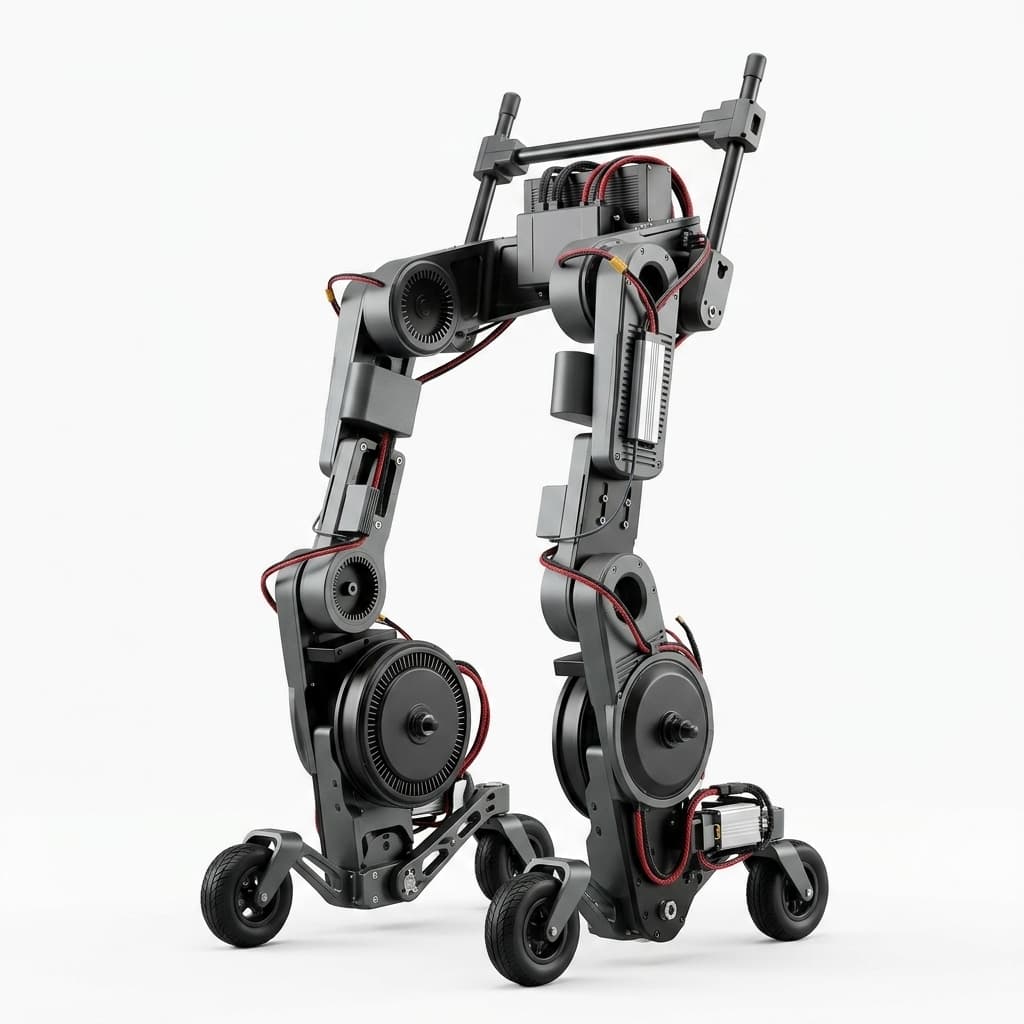
How Exoskeleton Motors Are Revolutionizing Wearable Robotics
Explore the critical engineering requirements for exoskeleton actuators, including weight, profile, backdrivability, and thermal management.